Thursday, December 31, 2009

New Year's Resolutions

In the past several years I have tried to make my New Year's resolutions stick. The best way to do so, I've found, is to be profoundly realistic.

For example, a few years back I resolved to be more judgemental, and to jump to conclusions more often. Another year, I decided to be more emotionally distant. Bingo! Success.

In the upcoming year, therefore, I resolve to resist thinking before speaking. And maybe to buy into more conspiracy theories. Like the moon landing hoax.

I just hope I have the dedication to follow through.

Feel free to leave your resolutions, sincere or otherwise, in the combox.

Watch Night Greetings


Paul Harvey


Our 3rd annual Watch Night post -- time for all to hear Bessie Jones's rendition of Yonder Comes Day (disk one, track 17).

Read more about it in
"Singing and Shouting in Moving Star Hall" (J-STOR access required; it's from Guy and Candace Carawan, "Singing and Shouting in Moving Star Hall," Black Music Research Journal 15, Spring 1995, pp. 17-28).

Happy New Year to all. For K. Lofton -- your annual CD compilation has already made my New Year a good one.

And for you historian-geeks out there, Ambrose Bierce is back with a Christmas/New Year's greeting, a la Roger Angell, much fun insider reading. I'll even forgive him that Mary Dudziak, Tenured Radical, Ralph Luker made the greeting, while RiAH contributors got shut out. Better luck next year. See you then.

Missed It by That Much


One more crackpot post for 2009...

The Old 'False-Flag Trick'


by William Norman Grigg


You know, Chief, this nude bomb might solve a lot of problems. For one thing, flashers.... And there'd be no more trouble with concealed weapons. I mean, if everyone were nude, there'd be no place to hide a gun or knife. Well, there is a place, but it could be painful.


--Maxwell Smart, the redoubtable Agent 86, finding the upside to KAOS's terrorist threat to destroy the world's clothing with its dreaded Nude Bomb.


In an utterly predictable response to an unsuccessful attempt by a would-be Jihadist to emasculate himself in mid-air by detonating a small explosive charge (a very small one, of course), the Regime is moving, slowly but inexorably, in the direction of requiring airline passengers to strip nude.


There is plentiful evidence to suggest that the same Regime acted as an accomplice – most likely a passive one – in that same failed bombing attempt. Call it a delayed-action nude bomb: One Nigerian nutcase conceals a firecracker in his wedding tackle, and before long everybody will have to strip nude in order to fly.


Granted, the nudity would be "virtual," temporary, and limited in its exposure. Passengers would be violated one at a time by the same thoughtful people who have made a career out of rifling through other people's dirty underwear.


Airport security screeners have "got to have some way of detecting things in parts of the body that aren't easy to get at," insists former Homeland Security Commissar Michael Chertoff. "It's either pat-downs or imaging."


A third alternative is to avoid commercial aviation outright whenever possible. I suspect an ever-larger number of Americans are going to join me in choosing what's behind door number three.


Government is the only human enterprise that profits from failure. Once that principle is understood, many otherwise inexplicable choices made by ruling elites and their servants can be made intelligible.


For instance, we can begin to understand the perverse persistence governments display in courting preventable catastrophes, and then capitalizing on such incidents to enhance their power to do exactly the same things that resulted in disaster. In this case, in addition to requiring the helotry to undergo unconscionable personal violations before flying, the Regime is exploiting the incident aboard Northwest Flight 253 to escalate the ongoing military assault on Yemen, thereby increasing the human misery that helps propel international terrorism.


And so it is that the Regime – which has squandered trillions of debased dollars in the name of "fighting terrorism" (hundreds of billions to build a domestic garrison state, and even greater sums to conduct wars of aggression overseas) – will continue to do exactly the same thing following an episode that demonstrates, beyond serious dispute, that the "war on terror" has done exactly nothing to make Americans safer.


While it's not clear that the flight was in mortal danger, it is clear that the plot failed because a detonator failed to ignite, and a group of passengers shed the shackles of government-imposed docility to subdue the terrorist suspect. The attempt to massacre the passengers of Flight 253 was stopped without the Regime's help – and in spite of what has to be considered, at very best, the Regime's criminal negligence.


Owing to what must have been an anguished report from his father, Umar Abdulmutallab was known to the CIA and the State Department as a potential terrorist. Umar Abdulutallab the elder, a banking official from Nigeria, met personally with CIA officials to express concerns that his son – who had gone to Yemen for the supposed purpose of studying Arabic – was falling into the company of suspected terrorists.


U.S. officials took this valuable intelligence and promptly buried Abdulmutallab's name in an official database. Yet it was not placed on the official "no-fly list"; apparently, that status is reserved for people who make themselves troublesome to the Executive Branch without actually posing a threat to innocent people.


Additional layers of official negligence were revealed by a passenger named Kurt Haskell, who was next to Abdumutallab as the would-be bomber checked in at the airport in Amsterdam:


"An Indian man in a nicely dressed suit around age 50 approached the check in counter with the terrorist and said `This man needs to get on this flight and he has no passport.' The two of them were an odd pair as the terrorist is a short, black man that looked like he was very poor and looks around age 17 (although I think he is 23 he doesn't look it). It did not cross my mind that they were terrorists, only that the two looked weird together. The ticket taker said `you can't board without a passport.' The Indian man then replied, `He is from Sudan, we do this all the time.' I can only take from this to mean that it is difficult to get passports from Sudan and this was some sort of sympathy ploy. The ticket taker then said `You will have to talk to my manager,' and sent the two down a hallway. I never saw the Indian man again as he wasn't on the flight. It was also weird that the terrorist never said a word in this exchange. Anyway, somehow, the terrorist still made it onto the plane. I am not sure if it was a bribe or just sympathy from the security manager."


Haskell also says that he stood a few yards away from another Indian man who was handcuffed and held in customs "after a bomb sniffing dog detected a bomb in his carry on bag and he was searched after we landed. This was later confirmed while we were in customs when an FBI agent said to us `You are being moved to another area because this area is not safe. Read between the lines. Some of you saw what just happened.'.... What also didn't make the news is that we were held on the plane for 20 minutes AFTER IT LANDED! A bomb could have gone off then. This wasn't too smart of security to not let us off the plane immediately."


Assuming that Haskell's account is correct, Abdulmutallab received some variety of official help to board the plane, and was apparently part of a team of bombers. The reported connection to India is of particular interest, given a growing dispute between Mumbai and Washington over a Pakistani-born U.S. citizen allegedly involved in the 2008 terrorist rampage at the Taj Mahal Hotel that left 166 people dead.


Te Deum Laudamus: Te Dominum Confitemur

As we end the calendar year, here within the Octave of Christmas and on the Feast of Pope St. Sylvester I (of whom I can never think without recalling Benson's Lord of the World), ready to usher in the New Year tomorrow on the Feast of the Circumcision of Our Lord, I thought I would put out a few lines.


1. I pray that all my readers are having a blessed and holy Christmas; I thank you for the many well-wishes and words of encouragement you have sent during the year. I thank those whom I annoy for sending me the many amusing comments that usually lift my spirits--and only occasionally dampen them-- as well.


2. The end of the year is a traditional time of thanksgiving for the blessings of a loving, almighty God. So for myself, I thank Him most of all for His Being, His Love, and all that He does for us. It is pretty nice of Him to keep the world and all of us in existence, and He sent His only Son to suffer, die and rise to save us from sin. I thank God for His Holy Catholic Church, which is the means of the salvation of man. I am grateful for His Mother, and I thank her as well for all she does to assist me as I try to work out my salvation in fear and trembling. I renew my consecration of myself, my family, my work and all that I do to her. Mother, do with me as you will.


I thank God for the embarrassing bounty of spiritual and material blessings He gives me. My sainted wife, my beautiful children, the means to earn a living to support them, good friends, family and everything else.


I thank Him for our Holy Father, Pope Benedict XVI, who just might be Benedict the Great one day. Summorum Pontificum is not his only achievement, but it would be enough, I think, to merit the title. I thank God for the many faithful sons and daughters in the priesthood and religious life whom I have been privileged to meet and get to know, often because of this ridiculous blog, especially for my spiritual director.


And I thank Him for the Institute of Christ the King Sovereign Priest. I credit the Institute with being the oasis of the faith in my life.


3. St. Francis de Sales Oratory will be singing a solemn Te Deum in thanksgiving for the past year today at 5 pm. The faithful who attend may receive a plenary indulgence, under the usual conditions of detachment from sin, sacramental confession, Holy Communion, and prayers for the intentions of the Holy Father.

Te Deum laudamus:
te Dominum confitemur.


Te aeternum Patrem
omnis terra veneratur.


Tibi omnes Angeli;
tibi caeli et universae Potestates;


Tibi Cherubim et Seraphim
incessabili voce proclamant:


Sanctus, Sanctus, Sanctus,
Dominus Deus Sabaoth.


Pleni sunt caeli et terra
maiestatis gloriae tuae.


Te gloriosus Apostolorum chorus,
Te Prophetarum laudabilis numerus,
Te Martyrum candidatus laudat exercitus.
Te per orbem terrarum
sancta confitetur Ecclesia,


Patrem immensae maiestatis:
Venerandum tuum verum et unicum Filium;

Sanctum quoque Paraclitum Spiritum.

Tu Rex gloriae, Christe.
Tu Patris sempiternus es Filius.
Tu ad liberandum suscepturus hominem,
non horruisti Virginis uterum.
Tu, devicto mortis aculeo,
aperuisti credentibus regna caelorum.


Tu ad dexteram Dei sedes, in gloria Patris.
Iudex crederis esse venturus.


(kneeling)Te ergo quaesumus, tuis famulis subveni:
quos pretioso sanguine redemisti.


Aeterna fac cum sanctis tuis in gloria numerari.
Salvum fac populum tuum,
Domine, et benedic hereditati tuae.

Et rege eos, et extolle illos usque in aeternum.

Per singulos dies benedicimus te;
Et laudamus Nomen tuum in saeculum, et in saeculum saeculi.


Dignare, Domine, die isto sine peccato nos custodire.
Miserere nostri domine, miserere nostri.

Fiat misericordia tua,
Domine, super nos, quemadmodum speravimus in te.


In te, Domine, speravi:
non confundar in aeternum.

(Translation, because it's Christmas:)

We praise thee, O God :
we acknowledge thee to be the Lord.
All the earth doth worship thee :
the Father everlasting.


To thee all Angels cry aloud :
the Heavens, and all the Powers therein.


To thee Cherubin and Seraphin :
continually do cry,
Holy, Holy, Holy :
Lord God of Sabaoth;
Heaven and earth are full of the Majesty :
of thy glory.


The glorious company of the Apostles : praise thee.
The goodly fellowship of the Prophets : praise thee.
The noble army of Martyrs : praise thee.

The holy Church throughout all the world :
doth acknowledge thee;
The Father : of an infinite Majesty;

Thine honourable, true : and only Son;
Also the Holy Ghost : the Comforter.

Thou art the King of Glory : O Christ.
Thou art the everlasting Son : of the Father.
When thou tookest upon thee to deliver man :
thou didst not abhor the Virgin's womb.
When thou hadst overcome the sharpness of death :
thou didst open the Kingdom of Heaven to all believers.


Thou sittest at the right hand of God : in the glory of the Father.
We believe that thou shalt come : to be our Judge.


(kneeling) We therefore pray thee, help thy servants :
whom thou hast redeemed with thy precious blood.


Make them to be numbered with thy Saints : in glory everlasting.

O Lord, save thy people :
and bless thine heritage.
Govern them : and lift them up for ever.


Day by day : we magnify thee;
And we worship thy Name : ever world without end.


Vouchsafe, O Lord : to keep us this day without sin.

O Lord, have mercy upon us : have mercy upon us.
O Lord, let thy mercy lighten upon us :
as our trust is in thee.


O Lord, in thee have I trusted :
let me never be confounded.


---------------


Merry Christmas again, and a very happy and blessed New Year!

Wednesday, December 30, 2009

Dissertations on Dudeness, the Historical Profession, and Francis Asbury

Paul Harvey

Just following up on some of previously posted-about topics.

First, "Dissertations on His Dudeness," NY Times, December 30, has more on religion/philosophy, cult movies, and The Big Lebowski, which we had posted about here previously.

Secondly, over at Immanent Frame is more on "Religion and the Historical Profession," including several scholars weighing in on an uptick of interest in religion in the historical profession, as discussed in a recent AHA study and reported on by Inside Higher Ed; we blogged about it previously here (with links to all of the above). From the perspective of a Europeanist, Jonathan Sheehan of UC Berkeley points out that many of the great studies of the Reformation (to cite one of many examples) occurred during the alleged low period for study of religion a generation ago. He continues:

So what seems most interesting about these findings is not that we are attending to religion with renewed zeal. Rather, it is the eagerness of historians (myself included) to hitch ourselves to the religion train, to declare ourselves historians of religion, rather than historians who happen to study religious events, people, or phenomena.


Sheehan then goes on to reflect further on some of the dangers of according religion a field of autonomy that is often not so readily granted to other phenomenon: Whether it is 9/11 or modern evangelical politics, world circumstances lure us into believing in belief. They lure us into believing that, beyond the social, political, and cultural, there is a certain something, an area of faith, that stands apart. But of course, this is exactly what religions have always said about themselves. If historians don’t want do the work of religion, then I think we have to reserve judgment on the thesis of religious autonomy.

David Hollinger, the renowned intellectual historian at UC Berkeley, reflects on the necessary and healthy disconnection among some between religious faith and religion as a field of study. He writes:

Religion is too important to be left in the hands of people who believe in it. Finally, historians are coming to grips with this simple truth. Why this has happened and with what effects may differ from period to period, continent to continent, and religion to religion.

Here, I will comment on this transformation as visible in the field I know the best, 20th century United States history.The careful and sustained study of Protestantism, Catholicism, and Judaism in this particular field has been carried out primarily by scholars who profess some version of the faith they study. This has produced some wonderful work, and I am not suggesting that belief is a barrier to successful scholarship. But this religious demography of scholarship does narrow the inventory of perspectives brought to the field, and once in place it is self-reinforcing: it can create the impression that religious history belongs mostly to the religious, and that historians of a more secular orientation will compromise their secularity by getting involved at all. The current increase of interest in religion on the part of scholars in this field follows in large part from the breaking of the connection between belief and the object of study. Just as we have lots of studies of Nazis by people who have no sympathy for Nazism—to use an extreme example to make the point—so, too, can we have studies of Presbyterians by people who have no commitment to Presbyterianism and may indeed find its influence on American life to be more pernicious than not.


Finally, more one someone who most certainly didn't think that Methodism was "more pernicious than not" -- Francis Asbury, subject of a recent biography by John Wigger, which


we'll have further and more extensive discussions about up sometime in the next few months; we previously blogged about the book here. Wigger is interviewed about his huge new biography here and also here. Here's a little excerpt from the 2nd:
One of the things I hope this book does is raise questions for readers about the meaning of religious leadership in America. To some extent, we’ve misunderstood religious leadership. We’ve tended to focus on individuals who were great communicators, great preachers. But, if you look at the country’s largest religious movements—Methodists, Baptists, Roman Catholics—most Americans today can’t name a single figure who put these religious movements together in this country. Most Americans today don’t know who Francis Asbury is. I wanted to go back and find out what was it about Asbury that allowed him to do this with Methodism. The first thing I found was that he was never a great preacher.
Finally, I would just add that our contributor John Fea has more about all this (including a good short summary of the Immanent Frame contributions) on his own blog, so check that out too.

Joseph Smith Papers Project -- Job Announcement

Historian/Documentary Editor, Joseph Smith Papers Project-0900581

Application Process


Description

The Joseph Smith Papers Project is engaged in producing a comprehensive edition of Joseph Smith documents featuring complete and accurate transcripts with both textual and contextual annotation. The scope of the project includes Joseph Smith's original correspondence, revelations, journals, historical writings, sermons, legal papers, and other documents. Besides providing the most comprehensive record of early Latter-day Saint history they will also provide insight into the broader religious landscape of the early American republic. The Joseph Smith Papers Project is ready to hire a historian/documentary editor with the appropriate academic training, research and writing skills to edit Joseph Smith's papers.

  • • 30% Document analysis: bibliographical and physical description; provenance and custodial history; research regarding textual and documentary intention, production, transmission, and reception; composition of source notes and historical introductions.
    • 30%--Routine annotation: research coordination with project chronologists, cartographers, and genealogists; research and writing for chronological, geographical, and biographical notes, as well as glossary entries, organizational charts, and other forms of routine annotation.
    • 30%--Explanatory annotation: general research in the relevant sources available for the volume's period; general research regarding the major issues recurring in the volume's documents; research and writing of footnotes to clarify, explain, or illuminate passages that are unclear, challenging, or otherwise problematic.
    • 5%--Teamwork: regular participation in volume team meetings to address historical issues, coordinate research efforts, and correlate editorial treatment; occasional participation in project committees to expand or refine project resources, confront and solve new editorial problems as they arise, develop the project website, or address other project needs.
    • 5%--Professional development: keeping abreast of Joseph Smith biography and early Mormon history, attending and participating in selected academic conferences on an annual basis; serving occasionally in professional associations.
Qualifications

PhD (or doctoral candidate) in history, religious studies, or related discipline. Understanding of antebellum American history and major social and political themes of the time. Demonstration of excellent writing skills, typing proficiency and facility with current technical tools for data management and production. As the highest professional standards of documentary editing are expected of the position, including a rigorous production schedule, the applicant must exhibit the ability to work in an academic environment that requires personal initiative and collaborative competence in all aspects of the project. Professional and personal integrity required to maintain the trust and confidence of professional colleagues, department supervisors, and archivists working in other public and private repositories. Member of The Church of Jesus Christ of Latter-day Saints, and worthy to hold a temple recommend.

Son of Meatless Friday Wednesday

Some random items to cover today, sure to amaze your friends and baffle your enemies:

1. When will people start to ask some serious questions about why it is that the federal government must be the entity to administer airline and airport security? The TSA fails time and time again in stunts carried out by journalists and watchdog groups. These stories get mentioned, occasionally, on page B23 of mainstream newspapers, usually under a headline like "Fraternity prankster sneaks knife onto flight". The latest reported failure concerns the Nigerian bomber, who is reported to have connections to Al-Qaeda. Early reports indicated that a passenger was responsible for neutralizing this guy-- more ominously, reports also indicate he was assisted in his quest by someone who helped him to board the plane without a passport.
The response by our supposedly benevolent and clearly incompetent government is to issue regulations that prohibit passengers from getting out of their seats. But the response is always some kind of limit to our freedom. Always. Regardless of the party nominally in power. Consider:
  • The 9-11 killings led to the execrable Patriot Act, which gutted the ancient right of habeas corpus-- which dated back more than 500 years.
  • The bureaucracy created to ensure "security" in our country makes up lists of potential "terrorists" that encompass pro-lifers, states-rights and individual liberties advocates.
  • The Real ID Act was also foisted on us, which is supposed to make us "safer" by laying the groundwork for a national ID card, and by computerizing sensitive personal information. This of course works really well to keep illegal immigrants from getting driver licenses and auto insurance, thus raising our insurance premiums and causing hit-and-run cases to spike. It doesn't work really well to keep airlines from being attacked, as this latest case shows. Also, it allows crooks to "skim" our personal information off of our passport and "smart" IDs.
  • Every reported failure by the government causes ordinary citizens to suffer greater governmental control, pay more money, and become accustomed to being treated as sub-human.
  • Long lines, no shoes, no belts, no water, no shaving cream. Now, the call is out for immoral "full-body scanners". Why? So we will be safer. Yet a foreigner without a passport but with a bomb waltzes on the plane.
When will people wake up? This is ludicrous. If these terrorist threats are real, why are we so content to allow the government to continue to administer airline security? It has failed miserably. Why not allow the private companies to take over this function? Private companies have a vested interest in their planes not being blown up. Bad for business, yes? Private companies are motivated to succeed because their very existence is at stake. Not so with the government. Private companies have experience in providing for the security of their assets and customers. Armored cars seem to be a good example of a security system, privately implemented, that works well. Obviously, the nature of the threat is different in an airport, but the principles involved are the same.
About the only reason the government still does this is because it wants to. It wants the control. It either believes that it can do this job better, despite every appearance to the contrary, or else it doesn't really want the airlines to be too secure.
Did I just say that? Yes, but you know I'm a little off, right? I mean, what if there really isn't a terrorist threat? Nah, impossible.
2. The reports of the "defrocking" of St. Christopher have been greatly exaggerated, despite what you may have heard. I overheard part of a conversation at a restaurant recently concerning this topic. No, I wasn't eavesdropping. The parties involved were members of what my brother labelled, in an attempt at humor, the BHC-- as in, the Blue-Haired Crowd. They were speaking very loudly. All of them proudly stated they went to 12 years of Catholic school.
Well, one guy begins on how he wasn't going to give any money to the local seminary. Another talks about the lack of certainty in religion, and how the Catholic Church can be wrong. "Just like when they defrocked St. Christopher." Loud agreement by most, complete bewilderment by one. So, the guy relates how they said he didn't exist a few years ago and just booted him from the calendar, and "now you're not allowed to wear St. Christopher medals anymore." At this point I am slightly tempted to try to intervene, because this is not true. But I hold back, just in time to hear this retort:
"But I saw 'em sold over at Catholic Supply."
Whoa! This was the first time I began to doubt myself. Being sold at Catholic Supply is, at best, a 64% indicator of Catholicity. Don't get me started. So, I thought, maybe I'll blog on this.
The deal is this: St. Christopher is a saint. He existed. He was a martyr. His cult goes back at least a thousand years. His feast day is July 25, shared with St. James the Greater.
In 1969, the same people who tried to destroy the ancient Mass also were thoughtful enough to denude the Roman calendar of many, MANY saints. I mean, who would want to venerate a Saint when they could instead celebrate the awe-inspiring Year II, Cycle B, Wednesday after the 18th Sunday in Ordinary Time? Thank goodness, St. Christopher was not allowed to gunk up this new religious experience.
In any event, some of the saints were determined by somebody somewhere not to have enough historical evidence to allow them to be on the "official" calendar. This point of view is explained fairly well here. However, even the sceptics admit that he existed-- they just don't like the traditional pious stories believed about him.
But St. Christopher remains a saint, and his feast day is unchanged. It is still marked on the traditional calendar on July 25, and he is still listed in the Roman Martyrology-- the official listing of Catholic saints. Catholic Encyclopedia has an nice entry here.
3. The combination of the above two items leads me to conclude with a third. Somebody asked me over the weekend about how the blog was going. I made a polite reply, and then opined that my target audience might be very, very, very serious Catholics who love Catholic tradition, distrust the federal government, know what a tunicle is, believe that an apocalyptic event is about 5 minutes away at any given time, wish the Spanish Armada had won-- and those who love them.
That's why the seven of you reading this are my favorite people in the world. Have a great Wednesday!
Saint Christoper, pray for us!

Tuesday, December 29, 2009

Malls R Us


It's been a slow blogging week here as we're taking a little time off, but in the meantime, for your post-santum depression, enjoy this from our contributor Jon Pahl, about the film Mall R Us.

The Making of Malls R Us
by Jon Pahl

"I'm in a movie." This has been an effective attention-getting line for me lately at cocktail parties. It's most effective late in a liquid evening. And it works especially well as one-upmanship after another partygoer has just been singing his or her own praises.
But it's true. The film is called Malls R Us. It was directed by Montreal filmmaker Helene Klodawsky, who described her approach to the film as an attempt to tell "a kind of history that hadn't been written." I get about fifteen minutes of screen-time (not that anyone is counting) in a seventy-eight minute feature documentary. Roger Ebert gave it three stars (out of four) in his review, and called it "provocative."
Ebert's review also quotes me, without credit (of course), in its opening sentence: "Is a shopping mall a sacred place?" That's my question! But, then, Ebert continues: "Not a question often asked." Should I be proud, or embarrassed, about that?
In fact, I've been asking that question for twenty years, and some of the results can be found in my book, Shopping Malls and Other Sacred Spaces, which is how I got into the film.
Helene Klodawsky has been making movies with a progressive and historical bent about as long as I've been wondering about the spiritual significance of shopping malls (see a profile of her work, including an interview, here). She does her homework. So, when she was invited by producer Ina Fichman to "make a movie on shopping malls," she found my book, with the help of researcher Teri Foxman, and got in touch.
I was only too happy to "go Hollywood." And I'm happier to report that the film is a shrewd, interesting, and wryly funny exploration of mall culture and history. And I'm happiest to report that I don't come off as too much of a dork.
Making the movie must have been a globe-trotting blast for Helene. She filmed at malls in West Edmonton, outside Montreal, and in Paris, London, Osaka, Dubai, Delhi, and with me for three days in Philadelphia. She interviews architects and mall developers, along with mall critics, and includes some sterling historical footage. Historians will also appreciate the role of the guys at deadmalls.com, who have dedicated themselves to tracking dead or dying shopping malls around the U.S., or as they put in on their website, "Welcome to Retail History."
As a careful (and often visually-stunning) study of globalization and sacred space, and as a micro-history in the spread of American empire, the film is made for classroom purposes. It even includes some clips from my slightly-less-famous-than-Al Gore's powerpoint lecture, "The Desire to Acquire: Or, Why Shopping Malls are Sites of Religious Violence."
You can view the trailer (featuring yours truly, along with my son, Justin) at http://www.youtube.com/watch?v=wE7q7nDU0NE

Pope Benedict XVI - Safeguard the Family Founded On Marriage

VATICAN CITY, 27 DEC 2009 (VIS) - Before praying the Angelus on this Sunday of the Holy Family, the Pope reminded the faithful gathered in St. Peter's Square that "God wished to reveal Himself by being born in a human family, and hence the human family has become an icon of God.

"God is Trinity", he added. "He is communion of love, and the family - with all the difference that exists between the Mystery of God and His human creature - is an expression thereof which reflects the unfathomable mystery of God-Love. ... The human family is, in a certain sense, the icon of the Trinity because of the love between its members and the fruitfulness of that love".

Commenting then on today's Gospel reading which narrates how the twelve-year-old Jesus stayed behind in the Temple without His parents' knowledge, the Pope explained that "Jesus' decision to remain in the Temple was above all the fruit of his intimate relationship with the Father, but also the fruit of the education received from Mary and Joseph".

And he went on: "Here we may catch a glimpse of the authentic meaning of Christian education. It is the result of a collaboration that must always be sought between the educators and God. The Christian family is aware that children are God's gift and project. Hence it cannot consider them as it own possessions but, serving God's plan through them, is called to educate them in the greatest of freedoms which is that of saying 'yes' to God in order to accomplish His will".

The Holy Father them addressed some remarks to participants in the Feast of the Holy Family which is being celebrated today in Madrid, Spain. "God, by having come into the world in the bosom of a family, shows that this institution is a sure way to meet and know Him, and a permanent call to work for the loving unity of all people. Thus, one of the greatest services which we as Christians can offer our fellow men and women is to show them the serene and solid witness of a family founded upon marriage between a man and a woman, defending it and protecting it, because it is of supreme importance for the present and future of humankind.

"In truth, the family is the best school in which to learn to live the values that dignify individuals and make peoples great. There too sufferings and joys are shared, as everyone feels cloaked in the affection that reigns in the home by the mere fact of being members of the same family".

Benedict XVI prayed to God that family homes may always experience "this love of total commitment and fidelity which Jesus brought into the world by His birth, nourishing and strengthening it with daily prayer, the constant practice of virtue, reciprocal understanding and mutual respect.

"I encourage you - trusting in the maternal intercession of Mary Most Holy, Queen of Families, and the powerful protection of St. Joseph, her husband - tirelessly to dedicate yourselves to this beautiful mission the Lord has placed in your hands. Be sure of my closeness and affection", he concluded, "and I pray you carry a very special greeting from the Pope to those of your loved ones who suffer greatest need and difficulties".

Catholic seminary has 20-year enrollment peak

St. Meinrad, in Indiana, is ahead of national averages.

From The Associated Press
ST. MEINRAD — The nation's sixth-largest Catholic seminary is reporting its highest enrollment in two decades as more men flock to the southern Indiana campus to pursue the priesthood.

The influx of students has left the St. Meinrad School of Theology straining to find classroom and living space for students at the campus, 65 miles west of Louisville, Ky.

St. Meinrad, which trains future priests for dioceses in Kentucky, Indiana and across the nation, began the year with 121 students - its highest number since 1988.

Church leaders and seminarians said a combination of spiritual and practical factors are behind the growth.

The Archdiocese of Louisville's seminarian ranks were all but depleted in 2002 and 2003 at the peak of the child sexual abuse scandal involving numerous priests.

Some of the seminarians at St. Meinrad said that crisis actually prompted them to consider the priesthood. They said they believed the church would avoid repeating such scandals through more rigorous screening and training of would-be priests.

“I think that there is a sense of hope in the church” now, said Adam Carrico, of Pewee Valley, Ky., who is studying at St. Meinrad for the Louisville archdiocese.

“We've experienced some troubles,” he said, “but I think we've learned from what happened in the past, and there's kind of a sense we can move forward and there is a tomorrow.”

Part of St. Meinrad's growth also reflects increasing arrangements with dioceses around the country to train their seminarians.

Both the Louisville archdiocese and the seminary are ahead of the national average in seminarian enrollment, which has remained largely the same in the last 15 years as the Catholic population has grown, while the ranks of priests have aged and declined.

Louisville Archbishop Joseph E. Kurtz credited archdiocese leaders for starting to reverse declines in seminarians even before he arrived in 2007 from Knoxville.

When Kurtz arrived, six men from the archdiocese were starting in seminary.

Kurtz said there's “no magic number” for recruitment goals, but he said ordaining four or five priests per year would “be a great blessing” toward easing the priest shortage.

The archdiocese has two priests working with recruits in addition to their parish duties.

Kurtz holds an annual “dinner with the archbishop” to encourage youths to consider joining the priesthood or religious orders. This year, the event drew hundreds of teenagers, the most in recent memory.

Jerry Byrd, a student from the Indianapolis archdiocese, said his path to the seminary began more than a decade ago as he converted to Catholicism as a teenager.

“My whole concept of a priest was based on priests I knew,” he recalled. “They were old and bald and slow.”

But one such priest told a class of people converting to Catholicism that “we need young men” in the priesthood, because “without the priests, we don't have the sacraments; if we don't have the sacraments, then we're not a church.”

Wednesday, December 23, 2009

Everywhere and Nowhere: Religious History and Historiography


Paul Harvey


This piece is getting a lot of attention at various academic blog sites: "Religious Revival," Inside Higher Ed, December 21. It reports on an American Historical Association survey that Randall blogged about here before, which shows that religion is the "box" now most often checked by historians reporting on their specialities/interests, with a disproportionate number of younger historians reporting on religion as a field of interest/inquiry/research. From the article, a summary of reasons cited for the rise of religion in the field:


  • Interest in the rise of "more activist (and in some cases 'militant') forms of religion."
  • An "extension of the methods and interests of social and cultural history.
  • "The impact of the "historical turn" in other disciplines, including religious studies.
  • Increased student demand for courses on the subject.

Jon Butler, a professor of history, religious studies and American studies at Yale University, is quoted in the AHA report as saying: "I think the category has become more popular because historians realize that the world is aflame with faith, yet our traditional ways of dealing with modern history especially can’t explain how or why. In short, the ‘secularization thesis’ appears to have failed and so we need to find ways to explain how and why it didn’t die as so much written history suggests.


Robert Townsend of the American Historical Association reflects further on the study here in the December 2009 Perspectives of the AHA, with a bit more detail on the points summarized in the Inside Higher Ed. article.


Is it time to celebrate? Partly but not so fast. Trends and interests come and go; social history was king of the mountain a generation ago, but has gone into rapid decline according to these self-identification surveys. Yet social history is so ground into the assumptions and practices of the discipline, perhaps, that it seems superfluous for many to self-identify with that field as opposed to something more recognizably set (diplomatic history, military history, economic history, religious history, or whatever).


Further, in our forthcoming piece "Everywhere and Nowhere: American Religious History and Historiography," co-authored by Kevin Schultz (an occasional contributor to this blog) and myself and forthcoming in the March issue of the Journal of the American Academy of Religion, we suggest that the proliferation of American religious history in recent years has not necessarily centrally shaped the narratives of mainstream historiography of modern America (with the exceptions of the civil rights movement and the rise of the New Right). Here's the abstract to the piece:


A spate of recent polls show that Americans are as religious as ever, even if their affiliations to particular faith groups have somewhat faded. Furthermore, during the past two decades, historians of American religion have unearthed much new information, connecting American religion to broader currents of American life in numerous exciting ways. Despite these two events, we argue that religion has yet to become central to the way in which most historians of modern America (since 1865) tell their story—except in areas that are either racialized (the civil rights movement) or considered to be politically marginal (the New Right). Religion is everywhere in history, but nowhere in mainstream historiography. We explore some possible reasons for this fact, and then conclude by pointing out several directions in which religious history is currently moving, and in which an examination by mainstream scholars might benefit the field as a whole tremendously.


You'll have to wait for the rest later when it appears, but in the meantime sometime after the New Year Kevin and I will have an shorter op-ed piece for Inside Higher Ed summarizing our piece and how it reflects on the kinds of polls/surveys such as this one from the AHA.

Tuesday, December 22, 2009

Gustave O. Arlt Award

Our Ed Blum has won the 2009 Gustave O. Arlt award for his Reforging the White Republic. From the press release:

Professor Blum’s book discusses the influential role that religion played in the reunification of northern and southern whites after the U.S. Civil War. He argues that northern religious ideas of a “white republic” justified and promoted racial segregation, ultimately leading to nationalism and imperialism. Yale University professor Harry S. Stout called the book “powerfully written…a first-rate intellectual and cultural history” and Rice University historian Michael O. Emerson described it as “one of the finest studies of race and religion ever written.”

Parenthetically, I used Reforging in a graduate seminar this past semester to good effect. The students appreciated the fact that the book introduced them to so many new storylines and themes absent from the other accounts of Reconstruction and the Gilded Age they had read: Reconstruction-era radical missionaries, Dwight Moody, the 1878 Yellow Fever Epidemic, the WCTU, and the American-Filipino War.

It's pretty fine stuff indeed to have a book continue to win awards four years after its publication.

Monday, December 21, 2009

The Dude Abides -- Or Is He Just Stoned?

Paul Harvey

Cathleen Falsani's The Dude Abides: The Gospel According to the Coen Brothers, featured yesterday on NPR, takes up the question of the moral order to the movies of the Coen Brothers -- The Big Lebowski, Fargo, O Brother Where Art Thou, Barton Fink, and most recently A Serious Man. A little excerpt from the interview:


The hero of The Big Lebowski is portrayed by Jeff Bridges as a meditative — or perhaps stoned? — fellow with long hair and a beard. He might evoke the traditional representation of a messiah, though he spends the entire movie clutching either a joint or a White Russian.Though he may look like a slacker, says Falsani, "there's a deep centeredness to him."
The interview doesn't get much into the most obvious parallels, in O Brother, Where Art Thou, the film that turned Man of Constant Sorrow into a national hit and revived the great Ralph Stanley's career. Much of the latter part of the interview explores Marge Gunderson's role in Fargo, her moral centeredness amidst the chaos she finds around her as she uncovers the petty but gruesome murders in Brainerd.
As for The Dude, having known a few borderline mystics/definite stoners from my Berkeley days, I'd say there's a fine line between mysticism and stoner-ism -- the line between, say, Jeff Bridges's Dude and Judd Apatow's anything.

Stonewall Jackson and the Catholic Fathers

Paul Harvey

Over at Civil War Memory, Kevin Levin has an excellent post where, as usual on his blog, he whacks down some more persistent neo-Confederate mythology, this time concerning how Stonewall Jackson's Sunday Schools made the General a great friend of the black man. Levin uses our friend Charles Irons's The Origins of Proslavery Christianity to set this particular mission to the slaves in proper context:
Earlier I referenced Nat Turner and I did so because it is crucial to understanding this story. Charles Irons does a magnificent job of analyzing the degree of cooperation between white and black evangelicals in Virginia through the early 1830s. He notes that by 1830 there one-quarter of black Virginians (115,000) had been converted to evangelical Christianity and thousands more practiced outside of the church. In addition, Turner’s claims that God had inspired him to rise up against the white population worked to reinforce growing concerns among white evangelicals as to their ability to safely monitor black gatherings. Irons is instructive here:
Gripped by fear and mistrust for several months, white Virginians struggled to adjust to the sobering fact that converted slaves could unleash such savagery. Some, particularly nonslaveholders from the western portion of the commonwealth, suggested that only a general emancipation could save the state from racial Armageddon and pushed for a constitutional convention to consider such a measure. Others, including some white evangelicals still shocked by August’s carnage, favored simply denying slaves the privilege of religious expression. Stark choices: emancipation or an end to evangelization. Within two years, however, white evangelicals hadfound a way to move forward without either destroying blackreligion or freeing their slaves. No single ideologue emerged to articulate the new policy of constant white supervision right away; politicians and churchgoers independently stumbled toward the formula of aggressive oversight and proselytization. (p. 143)
Within this context, Jackson’s school makes perfect sense, though it should be pointed out that a school had been established in Lexington as early as 1843. While our popular perceptions paint Jackson as some kind of liberator who was ahead of the curve, Irons’s analysis provides us with a clearer understanding of how the school reinforced slavery and white supremacy in Lexington and the Shenandoah Valley. Jackson admitted as much himself when he noted that God had placed the black race in a subordinate position. Constant oversight allowed Jackson and the rest of thewhite population to continue to proselytize and at the same time monitor his black students’ understanding of themselves in relationship to God and the white community. One can only wonder what Jackson wouldhave said to a student who put forward the notion that slavery stood in contradiction to God’s law.
An ironic parallel with this may be found in our own Michael Pasquier's study Fathers on the Frontier: French Missionaries and the Roman Catholic Priesthood in the United States, 1790-1860, which now is showing up at its Oxford Press website and on Amazon, ready for order -- should be out in a couple of months. A brief description of the book here:


As they became more accustomed to the lifeways of the American South and West, French missionaries expressed anxiety about apparent discrepancies between how they were taught to practice the priesthood in French seminaries and what the Holy See expected them to achieve as representatives of a universal missionary church. At no point did French missionaries engage moredirectly in distinctively American affairs than in the religious debates surrounding slavery, secession, and civil war. These issues, Pasquier argues, compelled even the most politically aloof missionaries to step out of the shadow of Rome and stake their church on the side of the Confederacy. In so doing, they set in motion a strain of Catholicism more amenable to Southern concepts of social conservatism, paternalism, and white supremacy, and strikingly different from the liberal, progressive strain that historians have usually highlighted. Focusing on the collective thoughts, feelings, and actions of priests who found themselves caught between the formal canonical standards of the church and the informal experiences of missionaries in American culture, Fathers on the Frontier illuminates the historical intersection of American, French, and Roman interests in the United States.

In his book, Mike shows the inexorable force of slavery as an ideology and practice, compelling the Catholic missionaries he studies to take their stand. The kinds of informal education they sponsored for slaves ended up looking a lot like what the Protestants did, as well.

Friday, December 18, 2009

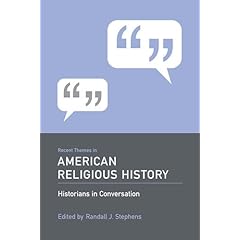
Recent Themes in American Religious History

Paul Harvey

Just in time for your holiday shopping season, my blog co-editor has put together a terrific series of conversations, essays, and responses on American religious history into a tidy volume: Recent Themes in American Religious History: Historians in Conversation. A brief description from the book's Amazon page:

Described as “the New York Review of Books for history,” Historically Speaking has emerged as one of the most distinctive historical publications in recent years, actively seeking out contributions from a pantheon of leading voices in historical discourse from both inside and outside academia. Recent Themes in American Religious History represents some of the best writing of recent years on understanding the context and importance of religious thought, movements, and figures in the American historical narrative.
This collection of essays and interviews from Historically Speaking address several subjects central to religious history in the Unites States. The first section maps the state of American religious history as a field of study and includes interviews with award-winning senior religious studies scholars Robert Orsi and Stephen Prothero. Subsequent sections explore the challenges of assimilation faced by Jews and Catholics in the United States, the origins and historical significance of American evangelical Christianity, and the phenomenon of millennialism in America. The volume concludes with a discussion of religious experience as an indicator of the limits of historical understanding, and of the tension that exists between the two modes of knowing.
Edited by Randall J. Stephens, Recent Themes in American Religious History will appeal to students, scholars, and general readers of American history, American studies, and religious studies. The contributors are Kathleen Garces-Foley, Nicholas Guyatt, Thomas S. Kidd, Thomas Kselman, Bruce Kuklick, George Marsden, Wilfred M. McClay, John McGreevy, Robert A. Orsi, James M. O’Toole, Stephen Prothero, Leo P. Ribuffo, Jonathan D. Sarna, Christopher Shannon, Jane Shaw, Stephen J. Stein, and John G. Turner.
Members of any Young Scholars in American Religion class will appreciate the book's dedication to the 2007-09 class of Young Scholars.
A highlight of the book for me is the conversation about Robert A. Orsi's well-known piece "Abundant History: Marian Apparitions as Alternative Modernity," with responses by Thomas Kselman and Jane Shaw.

Wednesday, December 16, 2009

Oral Roberts, Dead at 91

Randall Stephens

"Expect a miracle!" he told the millions who watched him on TV or attended his healing revivals. Few Christian leaders had the kind of influence or impact that Oral Roberts had.

With the recent passing of America's healing evangelist, I thought I'd post a couple of sections from obits here and provide some links. Roberts helped pentecostalism and the charismatic movement go mainstream in ways that would have been unimaginable in a previous generation. (If only Elvis had stayed in the AG church. Think of it!) Roberts life charted some of the most significant changes that pentecostals underwent from mid century to the present.

Keith Schneider, "Oral Roberts, Fiery Preacher, Dies at 91," NYT, 12/15/09.

Mr. Roberts’s will to succeed, as well as his fame, helped to elevate Pentecostal theology and practice, including the belief in faith healing, divine miracles and speaking in tongues, to the religious mainstream. During the 1970s, Time magazine reported, his television program “Oral Roberts and You” was the leading religious telecast in the nation. . . .

Mr. Roberts’s prominence and will to succeed were important factors in building the Pentecostal and charismatic movements and combining them into the fastest-growing Christian movements in the United States in the 1980s and 1990s and, by 2000, the largest Christian movement in the world. “No one had done more to bring the Pentecostal message to respectability and visibility in America,” David Edwin Harrell Jr. wrote in “Oral Roberts: An American Life” (Indiana University, 1985).

Bill Sherman, "Oral Roberts Dies," The Tulsa World, 12/15/09.

The often-controversial charismatic minister built Oral Roberts University, the now-closed City of Faith Medical and Research Center and the University Village Retirement Center in Tulsa.

He was a pioneer of the healing evangelism movement in the 1940s and ’50s and of radio and television ministry, which made his a household name to generations of Americans.

Roberts’ life was fashioned by what he described as a call to take “God’s healing power” to his generation, and every major effort he undertook was to that end.

See also:

Barbara Bradley Hagerty, "Oral Roberts, Pioneer Televangelist Dies," NPR, 12/16/09.

Charisma Magazine's collection of responses from the pentecostal charismatic community: "Healing Evangelist Oral Roberts Dies at Age 91," 12/15/09.

Blast from the past: See these Time magazine reports of Roberts's chilly reception in Australia (1956) and his damage control at ORU (2007).

I'm still waiting for Fox News or CNN to roll out Christopher Hitchens.

Tuesday, December 15, 2009

All You Need is Love (or, A Book I Should Have Read Three Years Ago)


I was doing many things back in 2006—namely, defending a dissertation, then beginning the laborious task of revising it. I was not, I regret, reading Debby Applegate’s thrilling and richly contextualized biography of Henry Ward Beecher, The Most Famous Man in America—and wouldn’t finally do so until last week. Paul talked a while back about a “boomlet in religious biography.” Applegate’s Pulitzer Prize winner puts the boom in boomlet. The book provides a window into the human (very human) side of perhaps the greatest of the many great reversals in American Protestant history: the transition from Lyman Beecher’s providential God, who already was warming up to the idea of human improvement, to his son Henry’s Gospel of Love, from which derives that warm fuzzy feeling I get every time I attend a Presbyterian Church, USA service. In short, Applegate offers a riveting coming-of-age story for liberal Protestantism. In the sense that Beecher was at the center of so much of mid-nineteenth century American history, the book also is a mini coming-of-age story for the nation itself. (Applegate proudly writes in the old-school—that is, pre-theory—American Studies tradition, which practically begs for such sweeping generalizations.)

Ward’s status as the man at the center got me thinking. Purportedly, more than a few conservative Protestants in this country are nostalgic for an earlier golden age of evangelical culture and influence, which likely occurred sometime in antebellum America. Likely, that is, just as Beecher started mucking everything up with his Gospel of Love and, if you believe the evidence in the book (from which Applegate, in an odd replication of the euphemistic ways of her Victorian subjects, skirts around outright conclusions), his propensity to express that love in diverse fashions. Maybe Beecher wasn’t a hypocrite, but rather a good anything-goes liberal, suggests this shallow reading of Beecher, which Paul smacked down when it surfaced in a Books & Culture review. But, if you think about it, shouldn’t fans of the old-time Christian America wish that, say, Ted Haggard’s own extramarital endeavors had caused as much of a stir as did the charge that Beecher seduced Elizabeth Tilton? Perhaps what evangelicals should really be nostalgic about is a period when an adulterous minister was the subject of a national scandal precisely because that minister had real influence outside of his home base. On the cusp of the Beecher-Tilton scandal, New York elites genuinely believed that revelations about Beecher’s exploits “would tend to undermine the very foundation of social order” (408). Say what you what you will about Ted Haggard, but he can only wish he had ever been a pillar of the social order. Besides, Beecher’s story would make a much richer movie. Anyone know if one is in the works?

by Steven P. Miller

Monday, December 14, 2009

Samson Occom's Dream

Paul Harvey

I blogged about this collection a couple of years ago, if I recall correctly, but time to do so again as I'm going through it now more carefully and thoroughly: Joanna Brooks, ed., the Collected Writings of Samson Occom, Mohegan: Leadership and Literature in Eighteenth-Century Native America (with a foreword by Native American scholar Robert Warrior) -- Oxford Univ. Press, 2006.

Occom is best-known as the student (and later critic) of Eleazar Wheelock, and Indian emissary for Moor's Indian Charity School in England for two years before returning to New England for a career as a minister, author of hymns, and increasingly bitter critic of the treatment accorded to himself and his people. He was the author of a short autobiography and a classic address at an eighteenth-century execution, "A Sermon, Preached at the Execution of Moses Paul, An Indian," from 1772. Those are of course reprinted here (the autobiography in 2 drafts, showing the handwritten amendments that you don't see in other reprintings).

What is especially fascinating here, though, are not the pieces that have dominated reprintings of Occom's work elsewhere, but the extensive letters, petitions, tribal documents, diary entries, and sermons, which document the daily texture of Occom's life. Brooks provides a splendid introduction which sets Occom in a different context than we see him in other literature:


Occom thought of himself first as a Mohegan with profound responsibilities to his own tribal community and to American Indian people in general. He was an herbal doctor, a hunter, a fisherman, a father, a husband, a tribal leader, and an intertribal political figure as well as an ordained Presbyterian minister, a schoolteacher, and an itinerant minister. . . . He could write a letter, preach a sermon, or tell a story by carving a box. . . Occom's elm bark box reminds us that English language literacy did not cancel out other forms of Native writing. It emblematizes the fullness, the richness, and the complexity of the thought-worlds inhabited by Occom and other early American Indian writers and intellectuals.


Occom left behind the "largest extant body of writing produced by an American Indian author before Santee Sioux intellectual Charles Eastman (1858-1939) began his writing career . . . " This volume is a much purchase for your university library, and a painstaking work of scholarly/literary recovery that brings to life a figure who often frustrates or disappoints readers who encounter him in the sparse documents reprinted in many anthologies.


Just as a taste, here is Occom's recording of a dream he had in 1786, of his friend George Whitefield, the famous evangelist and "divine dramatist" of the Great Awakening:

Last night I had a remarkable dream about [Mr] Whitefield. I thought he was preaching as he use to, when he was alive, I thought he was at a certain place where there was a great Number of Indians and Some White People - - and I had been Preaching, and he came to me, and took hold of my wright Hand and he put his face to my face, and rub'd his face to mine and Said, -- I am glad that you preach the Excellency of Jesus Christ yet, and Said, go on and the Lord be with thee, we Shall now Soon done, and then he Strechd himself upon the ground flat on his face and reachd his hands forward, and mad a mark with his Hand, and Said I will out doe and over reach all Sinners, and I thought he Barked like a Dog, with a Thundering Voice.


Here's a description of the work from its Oxford page:

This volume brings together for the first time the known writings of the pioneering Native American religious and political leader, intellectual, and author, Samson Occom (Mohegan; 1723-1792). The largest surviving archive of American Indian writing before Charles Eastman (Santee Sioux; 1858-1939), Occom's writings offer unparalleled views into a Native American intellectual and cultural universe in the era of colonialization and the early United States. His letters, sermons, journals, prose, petitions, and hymns--many of them never before published--document the emergence of pantribal political consciousness among the Native peoples of New England as well as Native efforts to adapt Christianity as a tool of decolonialization. Presenting previously unpublished and newly recovered writings, this collection more than doubles available Native American writing from before 1800.

The Formerly Evangelical Intelligentsia

Paul Harvey

Kiera Feldman, "New York Literati on Growing Up Evangelical," from Killing the Buddha, explores the early evangelical influences of writers James Wood ( critics for New Republic), Malcolm Gladwell (New Yorker staff writer known for Blink and other books), and Christine Smallwood (of The Nation). All three live and write on the grounds of what Wood called "disappointed belief," and a search for a substitute for the transcendent:

What remains in the absence of faith is the very question of secular life: how are we to feel deeply without access to the divine in everyday experience, warming our hearts with a love that is not of this world? And how are we to think?

Recommended piece.